Essay
How Civilizations Forget How to Think
The Hidden Cost of Censorship in the West
Every civilization survives by correcting its own mistakes.
Markets do not endure because merchants are honest. They endure because competition exposes bad prices. Science does not progress because scientists are infallible. It progresses because every theory is vulnerable to experiment and criticism. Democracies replace failed governments. Courts test arguments against opposing arguments. Healthy families confront painful truths before they become permanent tragedies. Civilization is remarkable not because it eliminates error, but because it builds institutions that expose error before it becomes fatal.
Speech belongs among those institutions.
We often describe free expression as an individual right—the liberty to say what one thinks without fear of punishment. That is true, but it misses the larger point. Speech is not merely a personal freedom; it is society’s mechanism for intellectual self-correction. It is how falsehoods are challenged, assumptions tested, institutions held accountable, and uncomfortable truths brought into the light. A society that loses confidence in open inquiry gradually loses confidence in its own ability to distinguish truth from comforting illusion.
The modern case for restricting speech is not without force. Words matter. They inspire revolutions, recruit terrorists, justify wars, and sometimes prepare entire populations for atrocity. It is reasonable to fear ideas that encourage hatred or violence. If speech can produce harm, then preventing certain kinds of speech appears to be a form of prevention itself. The impulse is understandable. Few people censor because they enjoy censorship. Most censor because they hope to protect others.
The mistake lies not in recognizing that ideas have consequences, but in assuming that prohibited ideas simply disappear.
They rarely do.
Ideas are remarkably difficult to kill. They move instead.
A man convinced that immigrants are destroying his country does not abandon that belief because a social media platform removes his account. A young Muslim angry about Western foreign policy does not cease asking questions because certain discussions become taboo. A teenager wondering about differences between groups, crime, religion, intelligence, or history does not lose his curiosity because adults declare those subjects off limits.
People denied one audience simply look for another.
And in the age of the internet, another audience always exists.
This changes the environment in which ideas develop. In public, controversial beliefs encounter criticism. They must compete against historians, scientists, journalists, ordinary citizens, and anyone willing to challenge them. Weak arguments are exposed. Stronger arguments survive. The process is imperfect, often chaotic, and occasionally unpleasant, but it is fundamentally corrective.
Private ideological communities operate differently.
Inside an echo chamber, disagreement gradually disappears. Members stop asking whether their beliefs are true and begin asking why outsiders refuse to acknowledge what has become obvious. Doubt becomes weakness. Nuance becomes compromise. Every criticism from outside confirms the group’s conviction that it possesses forbidden knowledge. The very act of censorship strengthens the emotional attachment to the censored belief. What began as an opinion slowly becomes an identity.
This is why suppression can produce the opposite of its intended effect. It does not merely remove ideas from public view. It removes them from public criticism.
The greatest casualty is often not the committed extremist but the merely curious.
Imagine a seventeen-year-old who asks an awkward question. Perhaps he has misunderstood a statistic. Perhaps he has encountered misinformation online. Perhaps he is genuinely trying to understand a difficult subject. Curiosity itself is morally neutral. It seeks an answer wherever one can be found.
If respectable institutions refuse to engage the question, someone else will.
The internet guarantees it.
Unfortunately, the people most eager to answer forbidden questions are often those least interested in truth. They offer certainty where scholarship offers complexity. They provide belonging where serious inquiry demands patience. The young man searching for one answer may instead inherit an entire worldview built upon resentment toward institutions that refused even to have the conversation.
Silence is not rebuttal.
It is abandonment.
This pattern extends far beyond political extremism. Every successful institution depends upon honest criticism. Businesses conduct audits because hidden problems become bankruptcies. Doctors diagnose disease before treating it. Engineers investigate failures before building the next bridge. Families survive because difficult conversations eventually happen. We instinctively understand that shielding problems from criticism does not solve them. It merely delays the consequences.
Communities are no different.
Yet modern public discourse increasingly treats criticism itself as a form of hostility, especially when directed toward vulnerable groups. The intention is often compassionate. History contains enough genuine prejudice to justify caution. Every decent society should reject discrimination and protect the equal dignity of every citizen.
But dignity cannot require immunity from criticism.
No neighborhood improves because crime cannot be discussed honestly. No school improves because failing students are treated as a public-relations problem. No religion reforms by refusing to confront corruption. No ethnic community benefits when internal dysfunction becomes too socially dangerous to acknowledge. Every lasting improvement begins with diagnosis, and diagnosis requires language capable of describing reality as it is rather than as we wish it to be.
The tragedy is that censorship often harms the very people it claims to protect.
When criticism becomes taboo, reform becomes difficult. External observers remain silent for fear of being called prejudiced. Internal critics remain silent for fear of being accused of betrayal. Politicians avoid uncomfortable truths because outrage carries immediate political costs while silence carries almost none. Journalists learn which stories create professional risk. Researchers quietly choose safer questions. Gradually, everyone adapts.
The problems remain.
Only the conversation disappears.
This is not usually the result of conspiracy. It is the result of incentives. Institutions naturally avoid visible controversy. A university president is far more likely to lose her position because a controversial speaker appeared on campus than because intellectual conformity slowly weakened academic inquiry over a decade. A technology company faces immediate pressure from advertisers, activists, governments, and the media whenever contentious content remains online. The long-term cost of suppressing discussion, by contrast, is nearly impossible to measure. Organizations therefore drift toward censorship because caution is rewarded while openness is punished.
The irony is profound.
Every civilization depends upon mechanisms that expose error. Yet when social pressure teaches people that certain observations cannot even be examined, error itself becomes protected. Society slowly builds an intellectual immune deficiency. Problems remain undetected not because they have disappeared, but because the institutions responsible for identifying them have learned that looking is dangerous.
There are, of course, limits to free expression. Direct incitement to imminent violence is not philosophical inquiry. Fraud is not debate. Criminal conspiracy is not an exchange of ideas. Civilized societies have always recognized these distinctions. The argument is not that every utterance deserves protection. The argument is that confusing discussion with endorsement, or inquiry with incitement, destroys our ability to understand the very forces we hope to resist.
The ultimate danger of censorship is therefore not that fewer people speak.
It is that fewer people think together.
Every civilization must decide which discomfort it fears more. The first is the discomfort of hearing offensive, mistaken, or even dangerous ideas spoken aloud, where they remain vulnerable to criticism, evidence, ridicule, and revision. The second is the discomfort of allowing those same ideas to disappear into private worlds where criticism no longer reaches them, where certainty replaces inquiry, and where resentment hardens into conviction.
The first demands confidence.
The second reveals fear.
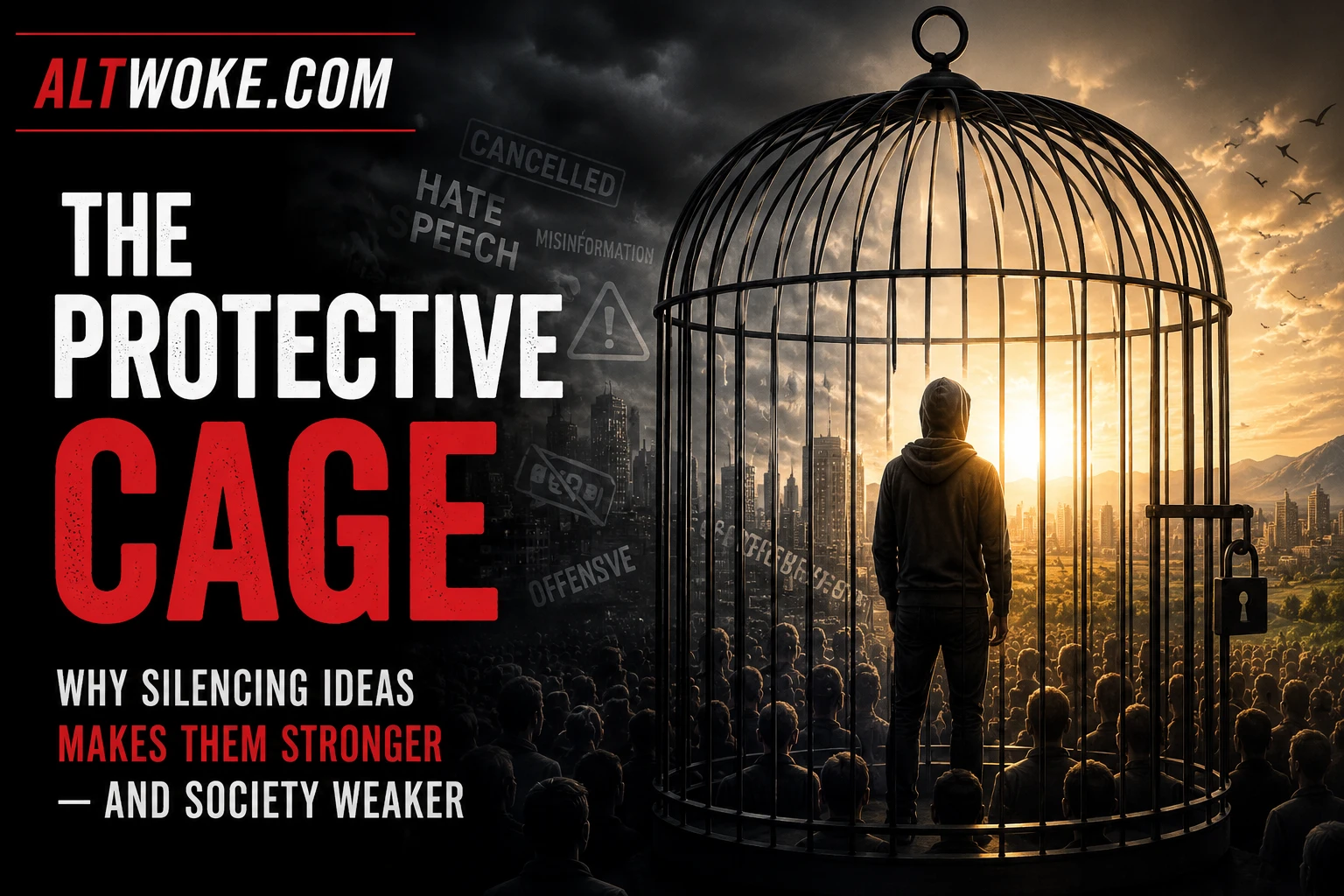
Every cage is built with a promise. It promises safety, order, and protection from whatever lies beyond its bars. Yet cages have a habit of outliving the dangers that justified them. In time they no longer protect society from harmful ideas. They protect harmful ideas from society—shielding them from scrutiny, contradiction, and correction until they emerge stronger than they entered.
That is the paradox of censorship.
In trying to protect civilization from its errors, it risks dismantling the very process by which civilization learns.
React to this essay
The discourse
0 commentsNo comments here yet. Be the first.