Essay
Europe’s Comfortable Illusion
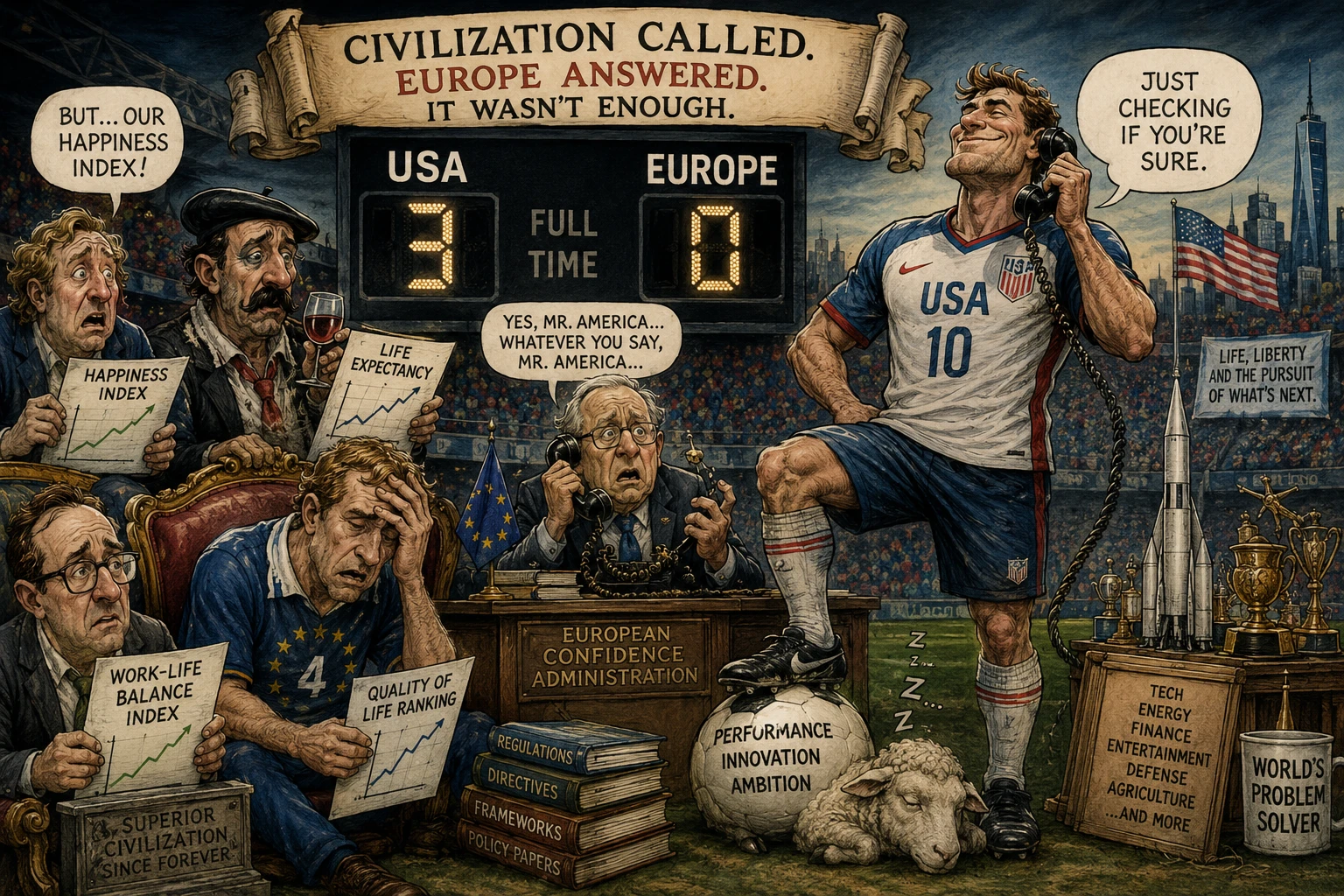
A satirical look at Europe’s faith in comfort, rankings, and inherited prestige—and the American habit of answering doubt with performance.
Before the World Cup, Europe performed its oldest and favorite ritual: mistaking familiarity for superiority.
The American team, they assured one another, possessed enthusiasm, athleticism, and all the charming innocence of a Labrador puppy. They would run hard, smile broadly, salute the flag, and eventually be escorted from the tournament by some continental artisan whose grandfather had first-trapped a football while composing an opera.
Then came reality.
The astonishment was almost touching. One could watch commentators perform intellectual gymnastics that would have embarrassed a circus acrobat. Every American victory required an explanation that carefully avoided the obvious one: perhaps the Americans had become rather good.
This is Europe’s peculiar disease. It is not arrogance in the ordinary sense. Arrogance admits the possibility of defeat. This is something deeper—a metaphysical certainty that civilization itself resides somewhere between Lisbon and Warsaw, and that everyone else merely rents it by the week.
One was reminded of that extraordinary spectacle during the recent political tensions, when it reportedly required a telephone call from Washington to stiffen European resolve. The same continent that spent generations composing treatises on sovereignty suddenly discovered that independence, like expensive wine, tastes better when someone else pays for it.
The irony was exquisite.
Here stood societies forever announcing themselves as the pinnacle of human development, yet apparently requiring periodic reassurance from the vulgar republic across the Atlantic—the nation of shopping malls, pickup trucks, and baseball—to remind them of their own convictions.
The contradiction would have delighted Mencken.
Europeans comfort themselves with spreadsheets masquerading as philosophy. They carry charts the way medieval monks carried relics.
“Our life expectancy is longer.”
“Our happiness index is higher.”
“Our work-life balance is superior.”
These are the rosary beads of modern bureaucratic civilization.
The longest life is not necessarily the fullest one. A sheep may enjoy remarkable longevity if the shepherd is diligent. A prisoner may experience admirable safety if his cell is sufficiently comfortable. Bureaucrats mistake survival for triumph because survival can be measured.
Nietzsche would have laughed himself breathless.
The Last Man does not conquer. He accumulates metrics.
He blinks contentedly before another government dashboard informing him that his subjective well-being has increased by 0.7%. He mistakes comfort for greatness and security for vitality. His highest aspiration is not to build cathedrals or cross oceans but to ensure that public transportation remains punctual.
The American, for all his absurdities, has never entirely surrendered to this creed.
He still believes, with almost embarrassing sincerity, that tomorrow may be larger than today.
Europe increasingly believes tomorrow should merely be safer.
These are not the same civilization.
Indeed, one begins to suspect that Europe’s endless insistence upon its refinement conceals an insecurity familiar to every psychologist. Truly great men rarely announce their greatness. They simply proceed with it.
It is only the anxious aristocrat who constantly reminds the dinner guests that his family once owned half the county.
Hence the endless recitation:
The healthcare.
The trains.
The vacations.
The happiness.
The sustainability.
The quality-of-life rankings.
The list grows longer precisely as confidence grows shorter.
Meanwhile, America commits its usual vulgar sins. It argues loudly. It invents recklessly. It wastes extravagantly. It commercializes everything from coffee to outer space. It produces millionaires and lunatics in approximately equal proportion.
And yet…
When catastrophe strikes, markets convulse, wars erupt, or technologies are born, the world still turns instinctively toward Washington, Silicon Valley, Wall Street, Houston, Boston, and Austin.
The supposedly uncivilized republic remains the civilization everyone secretly expects to solve the problem.
That expectation is the truest index of all.
Football merely exposed the broader habit.
Europe looked upon America and saw a rich barbarian incapable of mastering the subtleties of the world’s game. What it actually encountered was a nation that, once sufficiently interested, learns astonishingly fast.
That has always been America’s defining characteristic.
The Europeans studied the rulebook.
The Americans studied the scoreboard.
History suggests the latter method, however inelegant, has an unfortunate tendency to prevail.
Perhaps the deepest irony is this: Europe still imagines itself the teacher. America has long since become the graduate who stopped attending lectures because he was too busy buying the university.
Civilizations, like football teams, eventually discover that prestige cannot substitute for performance.
The scoreboard, unlike the happiness index, possesses one redeeming virtue.
It refuses to flatter.
React to this essay
The discourse
1 commentsCivilizations, like football teams, eventually discover that prestige cannot substitute for performance.
The scoreboard, unlike the happiness index, possesses one redeeming virtue.
1 more replies deeper in this thread.