Essay
The New Priesthood: Who Decides What You're Allowed to Think
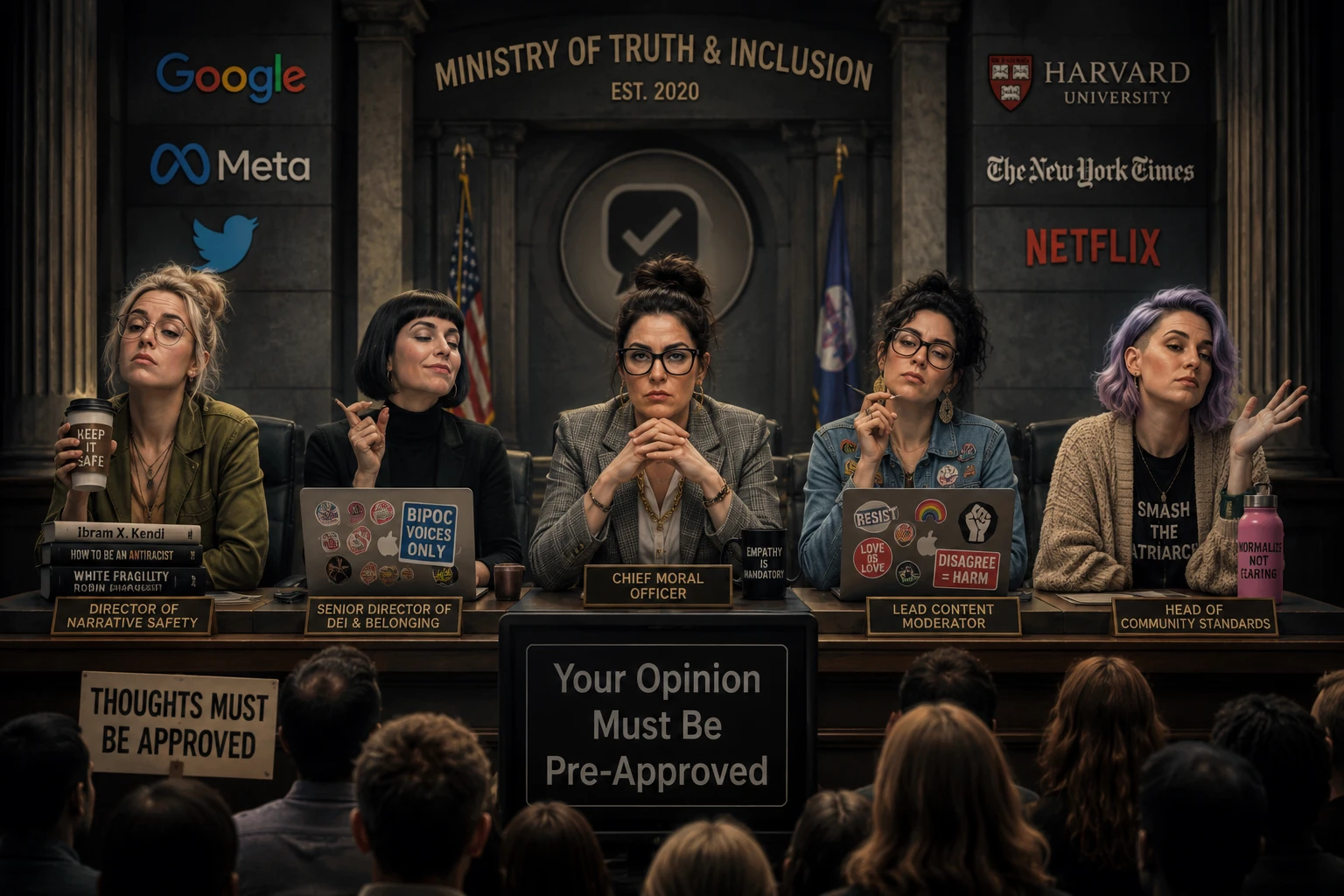
How Moral Authority Replaced Open Debate and Truth
Every civilization requires gatekeepers. No society has ever existed without institutions that distinguish acceptable ideas from unacceptable ones, respectable opinions from dangerous heresies, legitimate knowledge from forbidden speculation. The question is never whether such gatekeepers will exist, but who they will be, what authority they will claim, and how their power will be justified.
In medieval Europe, this authority belonged to the Church. Bishops and theologians determined which texts could be read, which ideas could be taught, which interpretations of scripture were orthodox and which were punishable by excommunication or death. The Church did not merely claim spiritual authority; it exercised temporal power over universities, publishing, law, and politics. To question its doctrines was to place oneself outside the community of respectable society.
In revolutionary France, the authority shifted to political committees. The Jacobins determined which citizens were sufficiently virtuous, which ideas were counter-revolutionary, which expressions of loyalty were adequate. The priesthood had changed its vestments, but the function remained: defining the boundaries of acceptable thought and punishing those who transgressed them.
In the Soviet Union, the Communist Party assumed this role. Intellectuals, artists, scientists, and ordinary citizens learned to navigate an elaborate system of ideological correctness. Certain questions could not be asked. Certain conclusions could not be reached. Certain facts could not be acknowledged. The priesthood wore different robes again, but the mechanism was familiar.
Today, in liberal democracies, we imagine ourselves free from such constraints. We have no official state religion, no political commissars, no formal censorship apparatus. Yet we do have institutions that perform remarkably similar functions. Universities, media organizations, technology platforms, professional associations, cultural institutions, and sprawling bureaucracies collectively determine which ideas are considered respectable, which questions are legitimate, which conclusions are permissible.
This is not a conspiracy. It is a natural consequence of how human societies organize knowledge, status, and authority. The people who occupy these institutions constitute what might be called the new priesthood. They are not priests in the religious sense, though many approach their work with comparable moral certainty. They are editors, academics, regulators, moderators, fact-checkers, diversity officers, human resources professionals, and credentialed experts whose collective judgments shape the boundaries of acceptable opinion. They decide which ideas receive funding, which research gets published, which voices are amplified, which careers are viable, which positions are respectable.
Before examining the problems this creates, it is necessary to understand why such a class exists and what legitimate functions it serves. The argument for gatekeepers is not trivial. Societies genuinely do require standards. Not all ideas are equally valid. Not all claims deserve equal consideration. A civilization that cannot distinguish between expertise and charlatanism, between careful reasoning and motivated nonsense, between good faith argument and deliberate fraud, will not remain civilized for long.
Consider the alternative. Without institutions capable of evaluating claims, how would anyone distinguish a competent physician from a quack? How would students learn anything reliable if every curriculum were equally valid? How would courts function if expert testimony carried no more weight than uninformed speculation? How would scientific knowledge advance if peer review did not filter out methodological errors and fraudulent data?
Gatekeepers also protect against genuine dangers. Misinformation about public health can kill people. Conspiracy theories can incite violence. Propaganda can destabilize democracies. Financial fraud can destroy economies. A society with no capacity to resist such threats would be vulnerable to every demagogue, con artist, and fanatic who could capture public attention.
Furthermore, most people lack the time, expertise, or inclination to evaluate every claim independently. Specialization is necessary in complex societies. We rely on doctors to understand medicine, engineers to design bridges, economists to interpret data, historians to contextualize events. This reliance requires trust, and trust requires institutions capable of certifying competence and punishing fraud.
The case for gatekeepers, then, is strong. The question is not whether societies need institutions that distinguish reliable knowledge from unreliable claims, respectable argument from disreputable nonsense. They do. The question is what happens when the authority to make such distinctions becomes concentrated within a relatively homogeneous professional class, insulated from external criticism, governed by incentives that reward conformity and punish dissent.
The new priesthood did not seize power through revolution or conquest. It accumulated authority gradually, through a combination of genuine expertise, institutional expansion, and the natural human tendency to defer to credentialed elites. Universities grew in size and influence throughout the twentieth century, becoming the primary gateway to professional success. Media organizations consolidated, creating a smaller number of outlets with greater reach. Professional associations established certification requirements that determined who could practice law, medicine, psychology, and dozens of other fields. Bureaucracies expanded, writing regulations that required specialized knowledge to navigate. Technology platforms emerged as the primary means of public communication, giving their employees unprecedented power to shape discourse.
Each of these developments had reasonable justifications. Universities expanded because modern economies required educated workers. Media consolidated because economies of scale made large organizations more efficient. Professional associations established standards because competence matters. Bureaucracies grew because complex societies require coordination. Technology platforms succeeded because they provided valuable services.
Yet the cumulative effect was to concentrate the authority to define respectable opinion within a relatively narrow class. The people who work in universities, media, technology companies, and prestigious bureaucracies tend to share similar educational backgrounds, live in similar cities, hold similar political views, and socialize within similar networks. This is not conspiracy. It is homophily, the well-documented human tendency to associate with people like oneself, combined with the structural incentives of institutions that reward conformity and punish deviation.
Consider the incentives facing an individual within such institutions. Expressing a heterodox opinion carries significant risk. Colleagues may question your judgment. Supervisors may doubt your suitability for promotion. Professional associations may investigate your conduct. Social media may amplify criticism. Funding may disappear. Job offers may evaporate. Friendships may end. The risk is not merely professional but social and reputational.
Expressing an orthodox opinion, by contrast, carries minimal risk and potential reward. It signals membership in respectable society. It demonstrates moral seriousness. It protects against accusations of complicity with dangerous ideas. It preserves relationships, career prospects, and peace of mind.
These incentives do not require centralized coordination. No committee meets to decide which ideas are acceptable. Instead, thousands of individuals, each responding rationally to the incentives they face, collectively produce an environment in which certain ideas become unspeakable not because they are prohibited by law but because expressing them is simply too costly.
Institutions reinforce these tendencies through various mechanisms. Universities cultivate ideological conformity through hiring practices, tenure decisions, and the peer review process. Academics learn which research questions are fundable, which conclusions are publishable, which frameworks are respectable. Deviation from these norms does not guarantee failure, but it dramatically increases risk.
Media organizations face similar pressures. Journalists depend on access to sources, approval from editors, and acceptance by peers. Reporting that challenges prevailing narratives or offends powerful constituencies can jeopardize all three. The result is not crude propaganda but a subtler form of conformity in which certain questions are rarely asked, certain possibilities rarely explored, certain explanations rarely considered.
Technology platforms face the most acute pressures because their decisions are visible, consequential, and subject to intense scrutiny from activists, regulators, advertisers, and employees. The safest course is to adopt increasingly expansive definitions of harmful content, misinformation, and dangerous speech. Each expansion reduces risk for the platform while narrowing the range of permissible discourse.
Professional associations and bureaucracies operate through credentialing and regulation. They determine who is qualified to practice, what standards must be met, which procedures are acceptable. Over time, these standards tend to expand, incorporating not merely technical competence but ideological conformity. Physicians, lawyers, therapists, and other professionals learn that certain opinions, even on matters unrelated to their expertise, can jeopardize their licenses.
The cumulative effect is a system in which the boundaries of acceptable opinion are policed not through formal censorship but through a diffuse network of reputational, professional, and social consequences. The new priesthood does not burn heretics. It simply makes heresy too expensive for most people to afford.
This system provides genuine benefits. It does filter out much fraudulent, dangerous, and low-quality information. It does protect expertise from being drowned out by confident ignorance. It does maintain standards that prevent complete epistemic chaos. These are not trivial accomplishments.
Yet the system also fails in predictable ways. It becomes risk-averse, preferring to suppress potentially true but controversial ideas rather than risk legitimizing potentially false but dangerous ones. It conflates moral transgression with intellectual error, treating heterodox opinions as evidence of moral deficiency. It expands the category of unacceptable ideas to include not merely claims that are demonstrably false or genuinely dangerous but claims that are merely uncomfortable, inconvenient, or incompatible with prevailing orthodoxies.
Perhaps most importantly, it creates a class of people who possess enormous authority to shape public discourse but face little accountability for error. When the priesthood is wrong, as it inevitably sometimes will be, the mechanisms that normally correct error through debate and criticism are weakened. Dissent is marginalized as irresponsible. Alternative explanations are dismissed as conspiracy theories. Contrary evidence is ignored or explained away.
History suggests that every dominant orthodoxy eventually produces its own priesthood, and every priesthood eventually overreaches. The medieval Church that preserved classical learning also burned scholars for studying the natural world too carefully. The Enlightenment that championed reason also produced the Terror. The progressive movements that expanded human freedom also created bureaucracies that stifled it. The pattern is not unique to any ideology. It is a consequence of how human institutions accumulate and exercise authority.
The question, then, is not how to eliminate gatekeepers. Societies require them. The question is how to prevent any priesthood from becoming unquestionable, how to preserve the capacity for error correction, how to maintain the tension between the need for standards and the need for intellectual freedom.
No perfect solution exists. The problem is structural, built into the nature of how civilizations organize knowledge and authority. But recognizing the problem is itself valuable. A priesthood that knows it is fallible is less dangerous than one convinced of its own righteousness. A society that understands the incentives governing its gatekeepers is better equipped to resist their overreach.
The goal is not to destroy the institutions that distinguish knowledge from nonsense, expertise from fraud, careful reasoning from motivated error. The goal is to ensure that those institutions remain open to criticism, accountable for mistakes, and capable of revising their judgments when evidence demands it. Whether such a balance can be maintained indefinitely remains an open question. But the alternative, allowing any group to possess unchallenged authority over the boundaries of respectable thought, has never ended well.
React to this essay
The discourse
0 commentsNo comments here yet. Be the first.